Designing Against the Monoculture: an Event-Driven Runtime
A single bad update once crashed 8.5 million machines in an afternoon. The bug was survivable. The architecture wasn't. Here's how to build so it can't happen to you.

Part of the pillar series Sovereignty You Can Actually Operate.
In the companion post we argued that ordinary tools quietly become critical infrastructure. This is the engineer's follow-up: given that concentration exists, how do you build a platform that a single faulty change cannot take down continent-wide?
The answer is older than the cloud. In 2003, security researchers Dan Geer and Bruce Schneier described software monoculture: when millions of systems share one codebase, "what one machine has, so has every other." A single defect becomes a population-level event (Schneier, 2003). Twenty-one years later, that thesis was proven at scale.
Anatomy of a continent-wide outage
On 19 July 2024, a security vendor pushed a content update that crashed roughly 8.5 million machines into boot loops. The published root-cause analysis is a precise anatomy of how a small bug becomes a global one (CrowdStrike RCA, 2024):
- A configuration template defined 21 input fields, but the sensor code supplied only 20.
- A content update referenced that non-existent 21st field, triggering an out-of-bounds read in kernel-mode code, an unrecoverable crash.
- The validator that should have caught the bad file had a logic error and passed it.
- And the decisive part: while the vendor's code shipped through staged rollout, the content update was pushed to the entire fleet at once, with no canary and no customer-controlled timing.
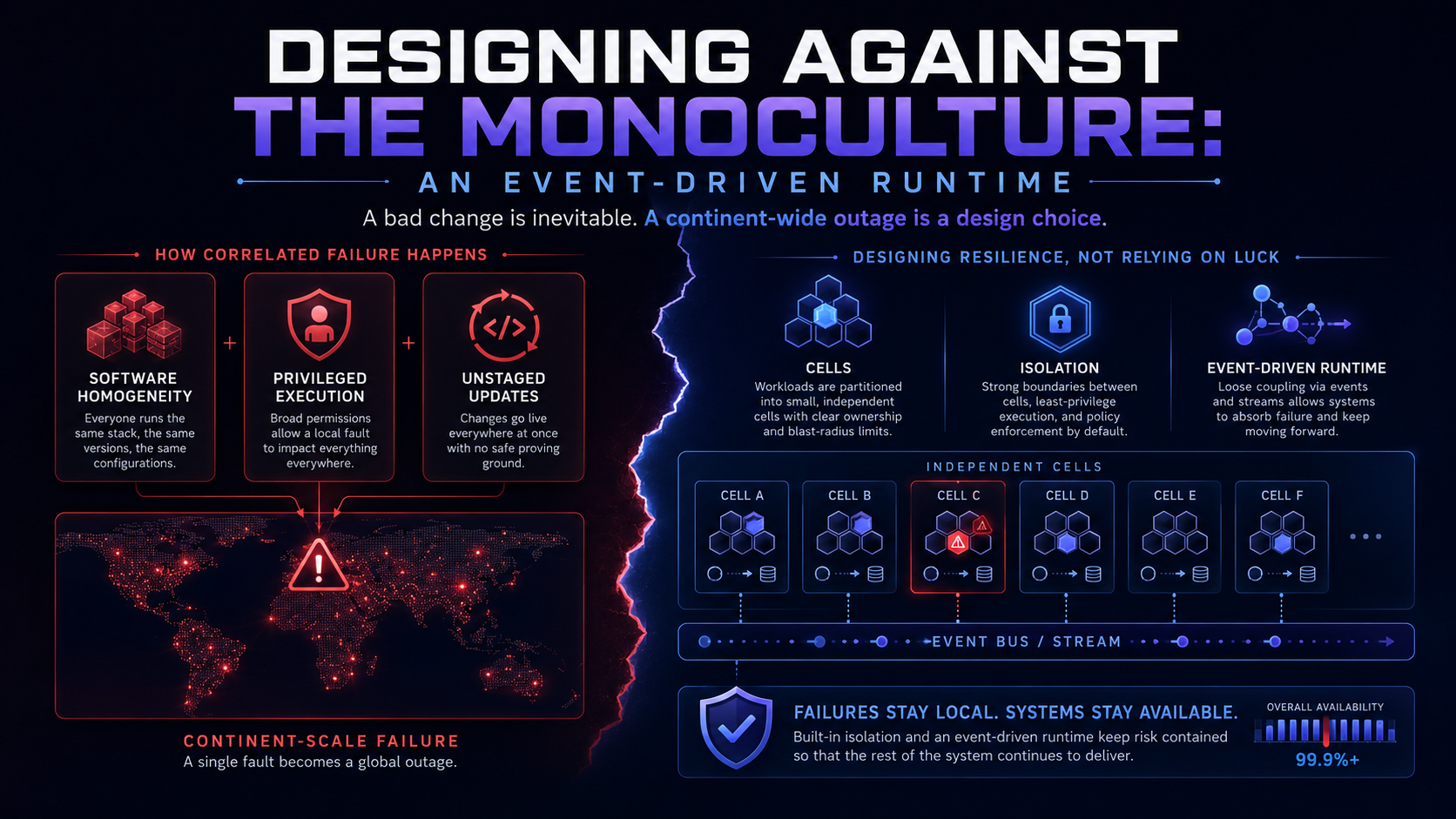
Three ingredients had to coincide: homogeneity (everyone runs the same thing), a privileged execution position (kernel code can crash the host), and a rapid, unstaged update channel. Remove any one and the blast radius collapses.
The transferable rule writes itself: if a change can brick the host, it ships in rings, whether you call it code, content, configuration, or data.
What is blast radius, and how to reduce it
Blast radius is the maximum impact a single failure can cause. Resilient systems are designed so that number is a fraction of the whole, never "everything and everyone." A handful of well-understood patterns do this:
| Pattern | What it isolates | How it limits blast radius |
|---|---|---|
| Cells (cellular architecture) | Independent stack replicas, each serving a subset of users | A failure hits ~1/N of users; deployments roll cell-by-cell |
| Bulkheads | Resource pools per tenant/dependency | A flood in one compartment can't drain the others |
| Shuffle sharding | Combinatorial virtual shards | A poison input hits one shard; nearly every customer gets a unique combination |
| Zonal / regional isolation | Geographic failure domains | A fault in one zone doesn't propagate |
| Control/data-plane split | Change machinery vs steady-state serving | The data plane keeps running even if the control plane is impaired |
Patterns drawn from established industry practice (e.g. AWS Builders' Library).
The principle behind all of them is the same: install boundaries so a failure is contained. As AWS's Colm MacCárthaigh puts it, without isolation "the scope of impact for this kind of failure is 'everything and everyone'" (Amazon Builders' Library).
Event-driven resilience: failure as a local, absorbable event
Patterns are necessary; a runtime that absorbs failure is what makes them work day to day. An event-driven design (components communicating through a message bus rather than calling each other directly) turns a fault into something local and recoverable instead of a synchronized crash.
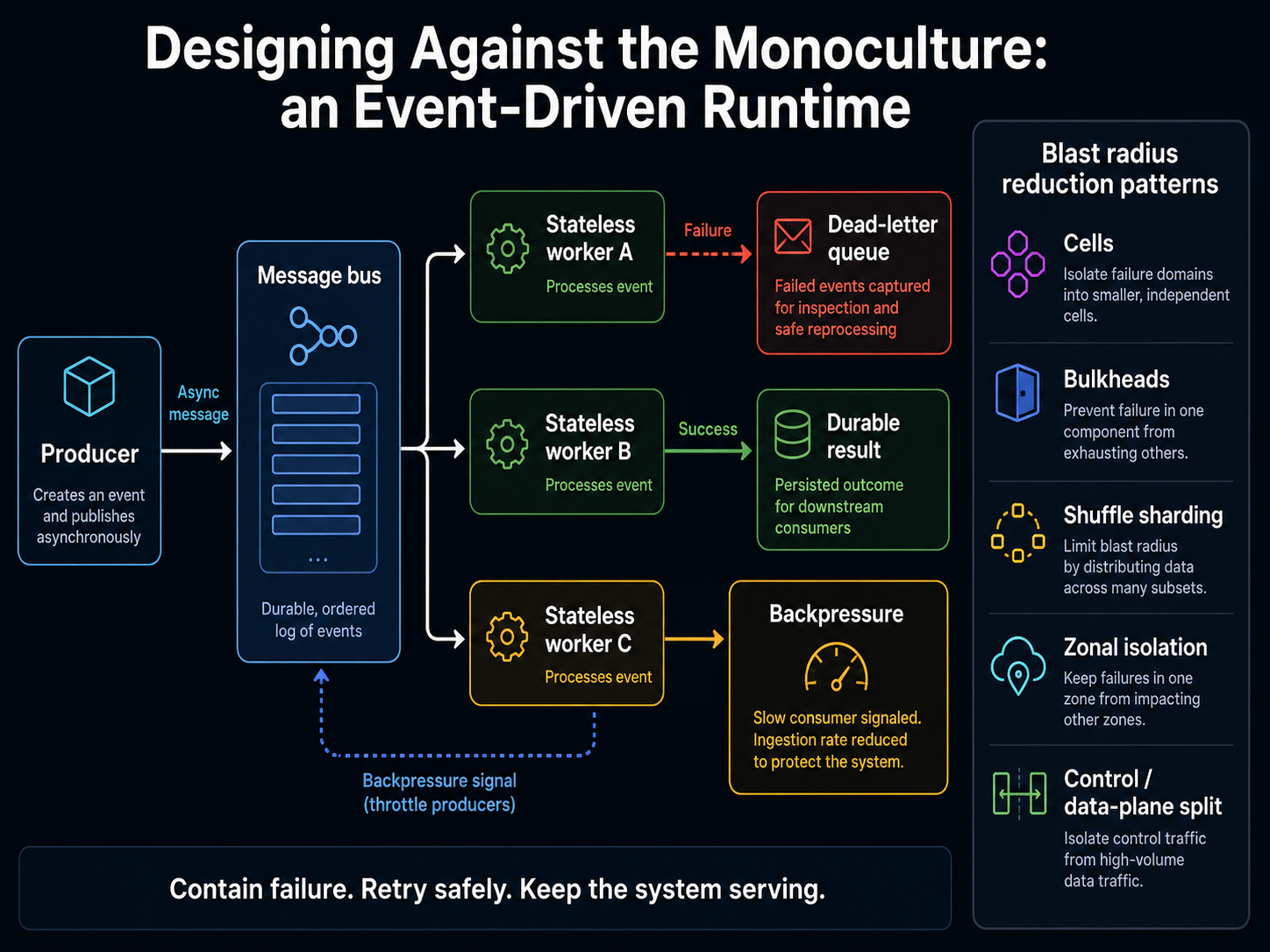
The load-bearing properties:
- Decoupling. A slow or failed consumer never blocks the producer; the bus holds the message.
- Stateless workers. State lives in the bus and the system of record, so any worker can pick up any job and a dead worker is replaced without data loss.
- Idempotency + retries with backoff and jitter. Duplicate processing is harmless and retries don't stampede.
- Dead-letter queues. One bad message is quarantined for inspection instead of poisoning the pipeline.
- Self-healing reconciliation. The system continuously converges toward its desired state. Recovery is steady-state behavior, not a heroic manual event.
Deployment safety: a deploy is an event, not a redeploy
The CrowdStrike lesson was ultimately about delivery, not C++. Treat every change, including configuration and content, as a discrete, observable, reversible event:
- Progressive / ring rollout. Expose a change to a small population first; expand only if health metrics hold.
- Automated rollback. Detect anomalies and revert to known-good without waiting for a human; at fleet scale, people are too slow.
- Configuration-as-data, validated. Config gets a schema, a validator that is itself tested, and the same staged rollout as code.
- Customer-controlled update rings. Let operators pause or stage updates, a principle the EU Cyber Resilience Act now echoes with its right to opt out of automatic updates.
Regulators have caught up to this, too. DORA, NIS2, and the Cyber Resilience Act now treat single-vendor concentration and uncontrolled auto-update channels as systemic risks to be managed, not stylistic preferences (Kroll, 2024). CISA Director Jen Easterly called it "a useful exercise, like a dress rehearsal for what China may want to do to us" (Cybersecurity Dive, 8 August 2024).
How the Soveryne Cloud Foundation is built for the bad day
We built the Soveryne Cloud Foundation on these principles because resilience, like sovereignty, has to be a property of the architecture rather than a line in an SLA.
The foundation is event-driven by design: components communicate through a message-addressed bus, compute is stateless and rebuildable, and work that fails is retried, quarantined, or reconciled rather than allowed to cascade. It runs on geographically distributed compute clusters across the EU (no single site and no single provider to fail with) and treats every change as a staged, reversible event rather than a fleet-wide flip. Configuration reload is a first-class, observable operation, not a redeploy.
That same foundation is why, when something does go wrong, the blast radius is a contained event instead of a continent-wide outage. And because operational resilience is now something you must evidence, not just claim, Command lets you map and continuously validate those controls the way DORA and NIS2 expect.
FAQ
What is software monoculture? When a large population of systems runs the same software, so they share the same vulnerabilities and failure modes. A single defect or bad update can then affect the entire population at once: the digital equivalent of a crop monoculture wiped out by one pathogen.
How did monoculture make the 2024 outage worse? Millions of machines ran an identical agent in a privileged position and received the same update simultaneously, so one defective file produced a perfectly correlated, global failure.
What is blast radius, and how do you reduce it? Blast radius is the maximum impact of a single failure. You reduce it with isolation boundaries (cells, bulkheads, shuffle sharding, zonal isolation) and with staged rollouts, so a failure is contained to a fraction of the system.
What is a cell-based architecture? A design that runs multiple independent replicas ("cells") of the full stack, each serving a subset of users, with no shared fate between them, so a failure or a bad deploy affects only one cell.
A bad change is inevitable; a continent-wide outage is a design choice. See the event-driven, EU-sovereign foundation we built to contain it, explore the Soveryne Cloud Foundation, or read the companion post on why concentration is now a systemic risk.
Sources
- Geer, Schneier et al., CyberInsecurity: The Cost of Monopoly (2003): https://www.schneier.com/essays/archives/2003/09/cyberinsecurity_the.html
- CrowdStrike, External Technical Root Cause Analysis, Channel File 291 (2024): https://www.crowdstrike.com/wp-content/uploads/2024/08/Channel-File-291-Incident-Root-Cause-Analysis-08.06.2024.pdf
- CISA, Widespread IT outage due to CrowdStrike update (2024): https://www.cisa.gov/news-events/alerts/2024/07/19/widespread-it-outage-due-crowdstrike-update
- AWS Builders' Library, Workload isolation using shuffle-sharding: https://aws.amazon.com/builders-library/workload-isolation-using-shuffle-sharding/
- The Reactive Manifesto: https://www.reactivemanifesto.org/
- Kroll, CrowdStrike incident and systemic cyber risk under EU regulations (2024): https://www.kroll.com/en/publications/cyber/crowdstrike-incident-systemic-cyber-risk-eu-regulations
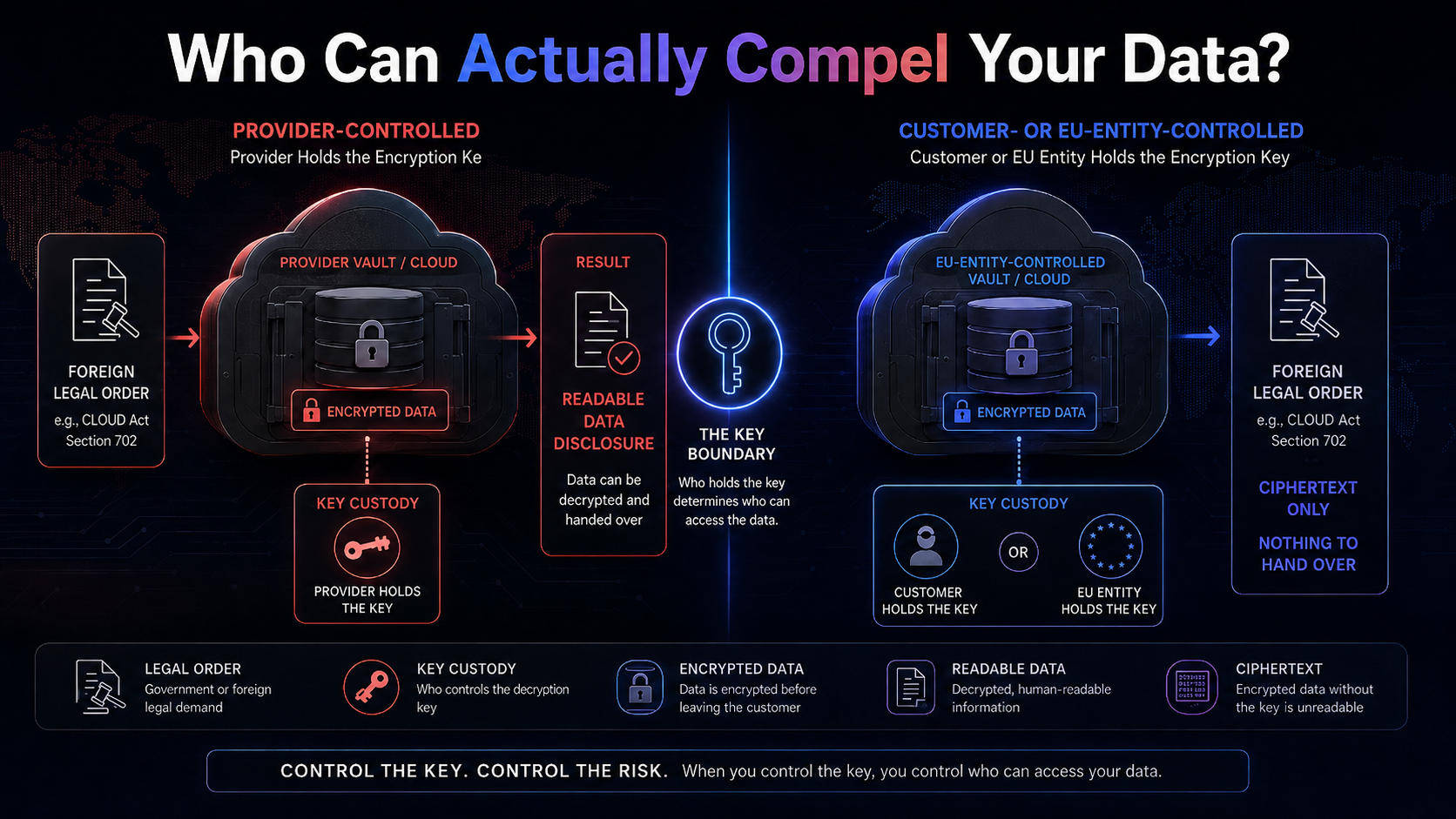
"Encrypted at rest" is the most reassuring phrase in enterprise IT, and one of the least informative. The question that actually decides your exposure is simpler and harder: who holds the keys, and who can be compelled to use them?
Read the next part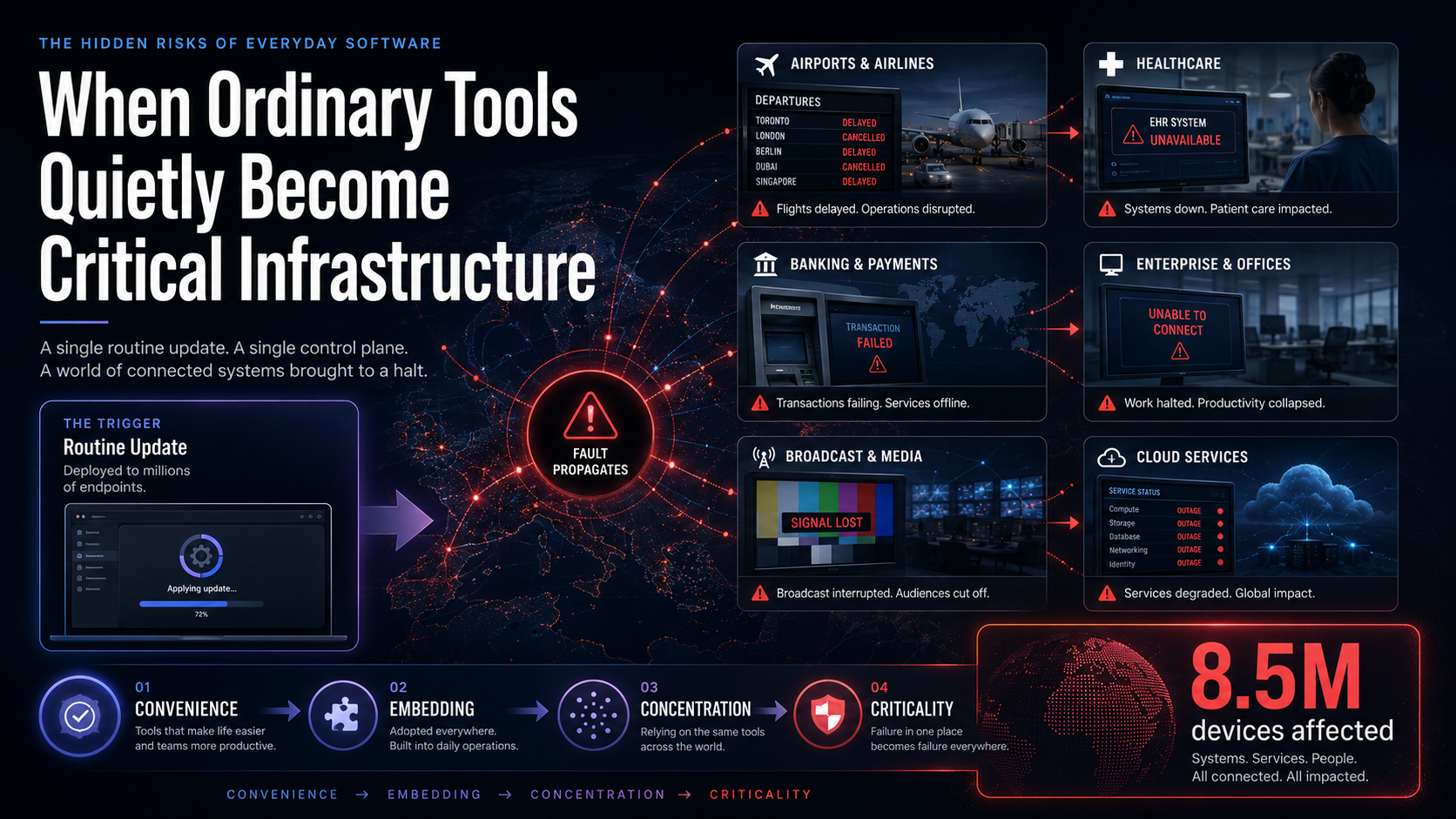
Nobody decides to make a SaaS tool load-bearing for the economy. It just happens, one convenient choice at a time.
Read the companion piece