From Obligation to Assurance: Board Accountability and Continuous Compliance
For years, compliance was something the board delegated and heard about once a year. Two EU laws ended that arrangement, by putting the board's own name on the liability. This final post is about what changes when compliance becomes a governance function the board personally owns.

Part of the pillar series Sovereignty You Can Actually Operate.
This is practical guidance for boards and compliance leaders, not legal advice. Current as of July 2026.
The liability moved into the boardroom
The most consequential shift in EU digital regulation isn't a new obligation: it's who answers for it.
- NIS2, Article 20: management bodies must approve and oversee cybersecurity risk-management measures, must take training, and can be held personally liable. Several Member States can impose sanctions including temporary bans on individuals holding management positions.
- DORA, Article 5: the management body bears ultimate, non-delegable responsibility for the ICT risk-management framework; it must approve the resilience strategy, continuity and recovery plans, and critical third-party arrangements, and keep its own knowledge current.
- GDPR, Article 5(2): the accountability principle already required the organization to demonstrate compliance.
- The AI Act adds governance and quality-management duties for AI.
Read together, these say something new: a director can no longer treat compliance as someone else's paperwork. The obligation to oversee, and the liability for failing to, sits with the board itself.
Why "we passed the audit" is not "we are assured"
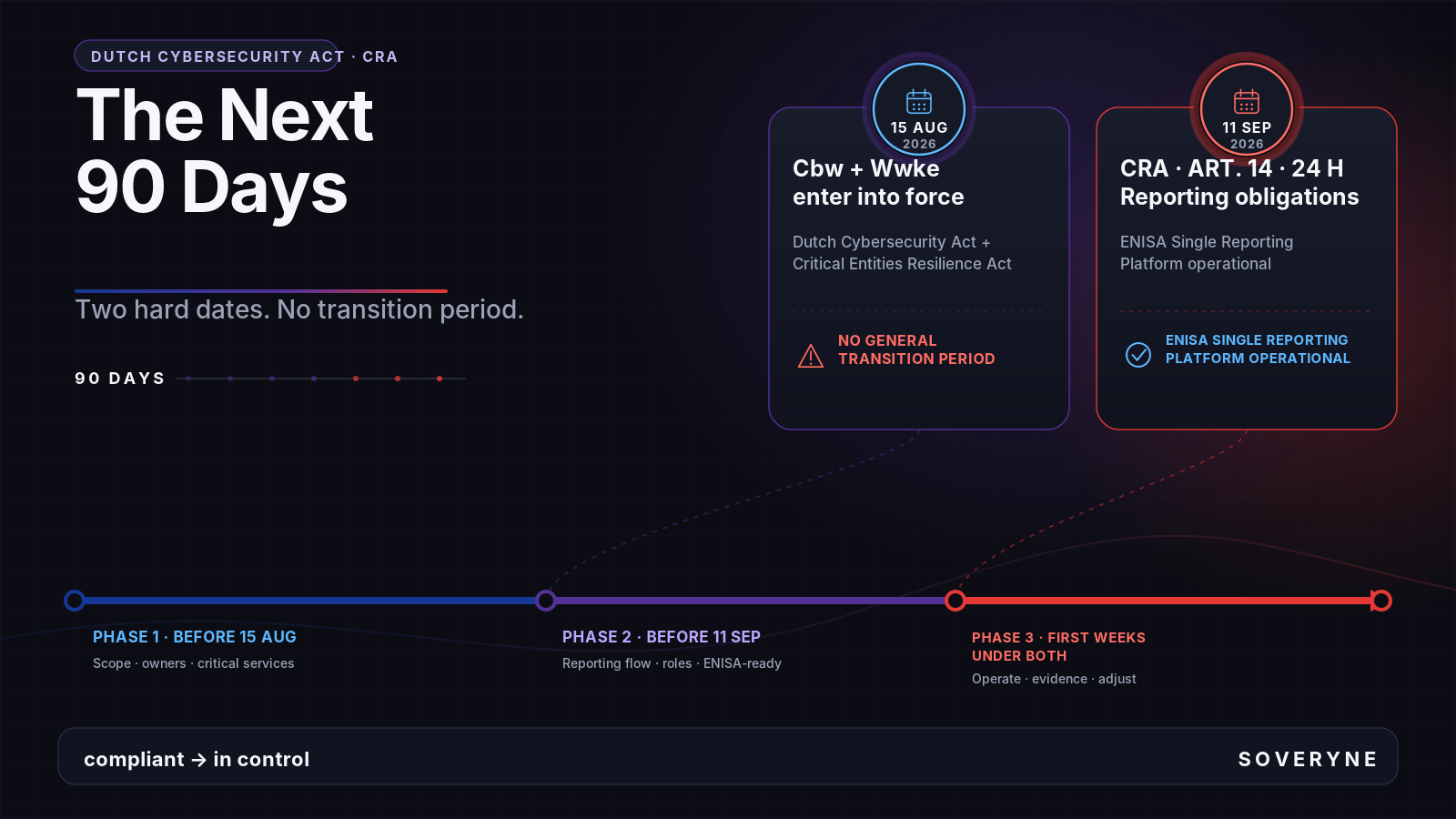
Here's the trap that catches boards. A certificate or an annual audit is a point-in-time stamp. It attests that on the day of assessment, controls looked adequate. But the environment changes, the estate changes, and (as this series has shown repeatedly) the law changes. The AI Act's deadlines moved in mid-2026. NIS2 enforcement hardened weeks later. A certificate issued against last year's understanding is quietly out of date.
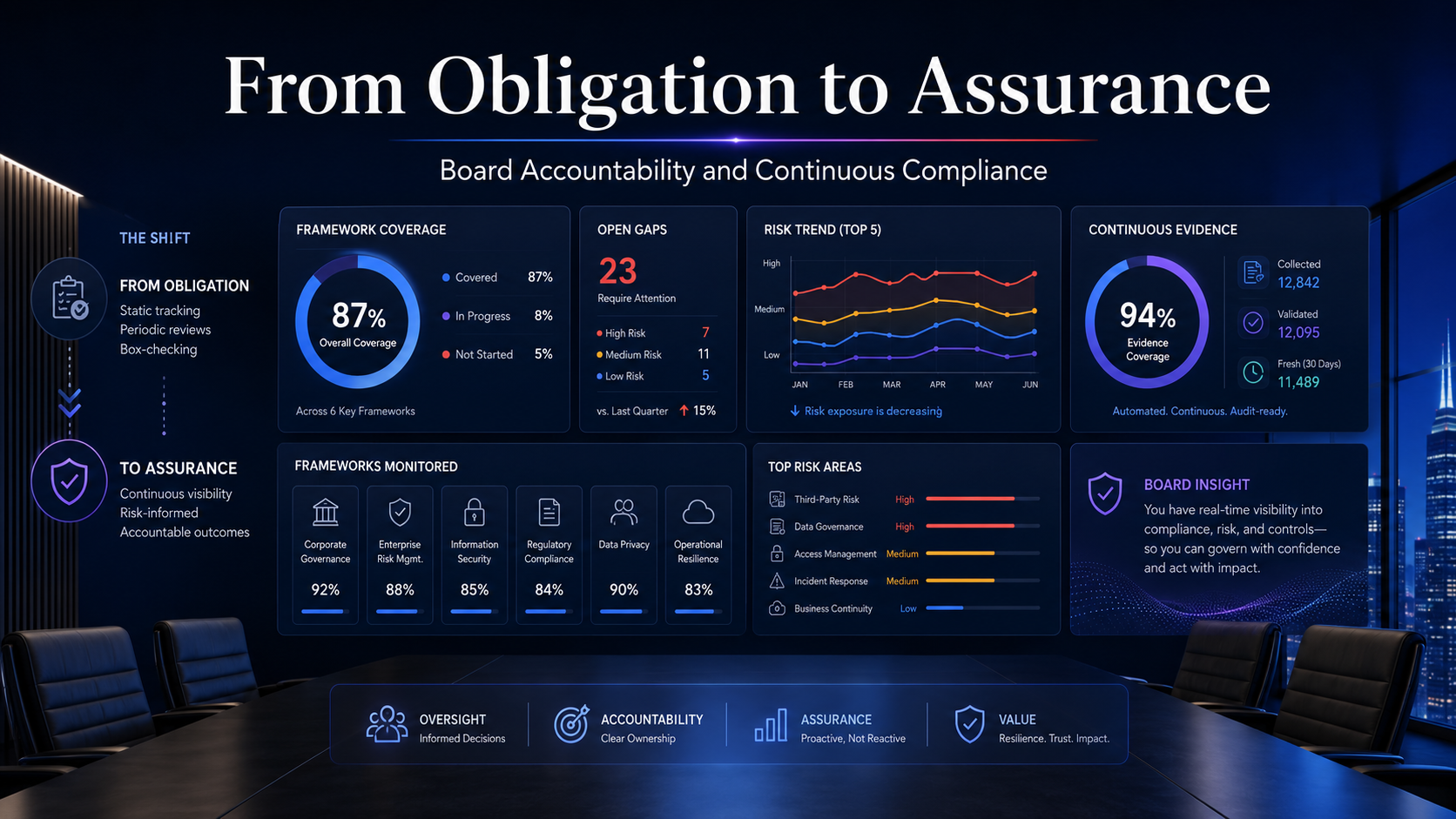
Continuous assurance is the alternative: an always-on, dated, inspectable stream of evidence, plus a live view of coverage, open gaps, and trend. The distinction matters because "compliant" and "assured" are not the same word. Compliant is a status you claimed on a date. Assured is a property you can demonstrate right now.
What the board actually needs to see
Directors don't need the control library; they need a decision-useful view of exposure. A board-ready compliance picture answers five questions on one page:
| The board asks | The assurance view shows |
|---|---|
| Are we covered? | Framework coverage %, per applicable law |
| Where are we exposed? | Open gaps, ranked by risk |
| Are we improving? | Remediation trend over time |
| What's coming? | Upcoming regulatory dates and their owners |
| Can we prove it? | Evidence freshness: nothing stale |
That's the artifact that turns a compliance program into governance a board can sign off (and, when a regulator or an incident comes, defend).
Where Soveryne fits
This is where the whole series lands. Command is built to produce exactly this view: framework coverage and control posture at a glance, open gaps by framework, and continuous validation so the evidence behind the picture is current rather than a year old. It turns "we passed the audit" into "here is our live, evidenced posture across every framework that applies to us": the difference between a stamp and assurance, and precisely what a board carrying personal liability needs to see. The dashboard the board reviews and the control library the team operates are the same system, so there's no gap between what's reported and what's real.
And because the board's questions are often about change ("what does the new rule mean for us?"), Counsel gives directors and their advisors grounded, cited answers on obligations and what's shifting, from the frameworks themselves. Coverage intelligence for the questions; proof of implementation for the answers.
If you've followed this series from the maze to here, the throughline is simple: compliance became a mapping-and-evidence problem, the evidence has to be continuous, and the board now owns the result. Soveryne is built to make that ownership defensible rather than nerve-wracking. Get in touch and we'll show you your posture across the frameworks that apply to you, and if we're not the right fit, we'll say so.
FAQ
Can board members be personally liable for compliance failures? Under NIS2, yes: management bodies must approve and oversee cyber measures and can be held liable, with some Member States allowing temporary management bans. DORA makes the management body's responsibility for ICT risk ultimate and non-delegable.
What is continuous compliance? An always-on approach where controls are evidenced continuously and coverage, gaps, and trend are visible in real time, as opposed to a point-in-time audit that attests to a single moment and decays as the environment and law change.
Isn't passing an audit enough? An audit or certificate is strong evidence for a point in time, but it doesn't stay true as your estate and the regulations change. Assurance means being able to demonstrate your posture now, not last year.
What does a board need to see about compliance? Coverage by framework, open gaps ranked by risk, remediation trend, upcoming regulatory dates, and evidence freshness: a decision-useful one-page view of exposure, not the full control library.
Compliance is now the board's to own. Make it defensible, not nerve-wracking. See your live, evidenced posture across every applicable framework in Command, and get cited answers on what's changing from Counsel. Get in touch.
Sources
- NIS2, Article 20 (management accountability): https://eur-lex.europa.eu/eli/dir/2022/2555/oj
- DORA, Article 5 (management body responsibility): https://eur-lex.europa.eu/eli/reg/2022/2554/oj
- GDPR, Article 5(2) (accountability): https://eur-lex.europa.eu/eli/reg/2016/679/oj
- European Commission, NIS2 enforcement (CJEU referral, 8 July 2026): https://ec.europa.eu/commission/presscorner/detail/en/ip_26_1499