The Region Lock: Selective Autonomy, in Code
In the companion post we argued sovereignty is a dial, not a wall, a framing the EU's own Joint Research Centre backs, noting that digital sovereignty "must not be conflated with isolation or protectionism" (JRC, Open but Not Powerless, 2025). This is how you build the dial, and, just as importantly, how you prove it's actually connected to anything.

Part of the pillar series Sovereignty You Can Actually Operate.
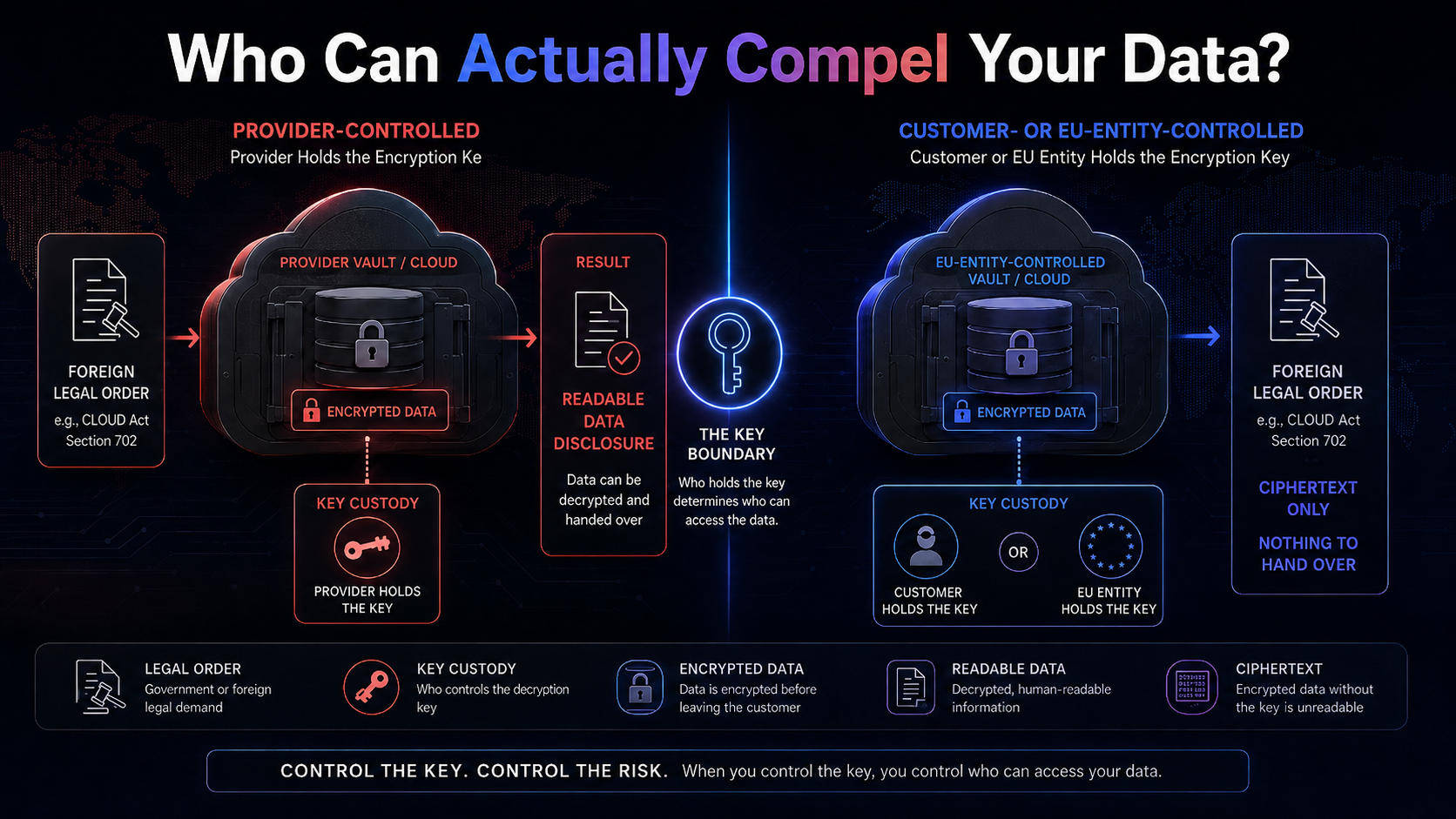
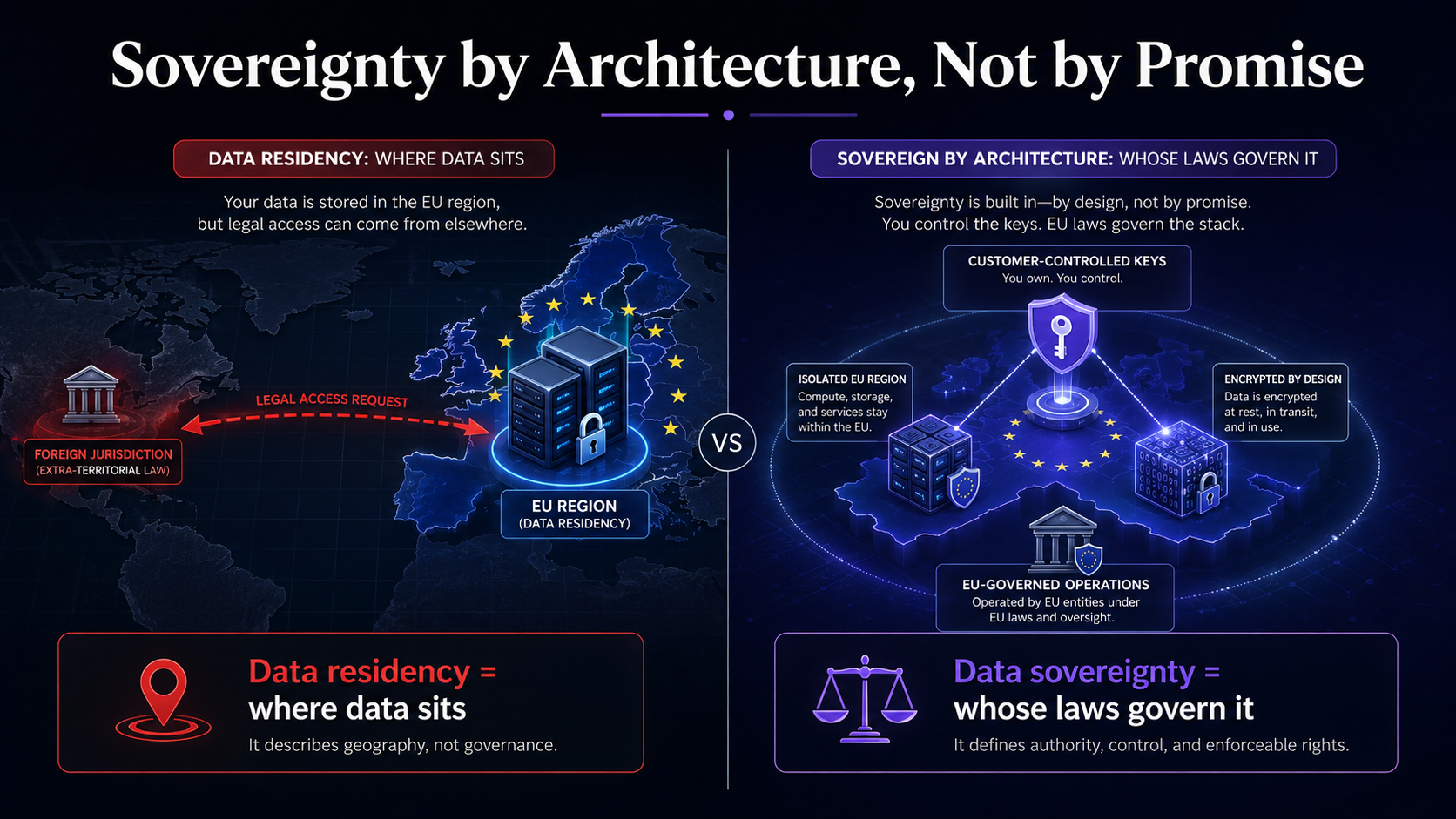
"Your data stays in the EU" is a sentence. Sovereignty is whether that sentence is enforced at every layer that touches the data, and whether you can run a test that fails if it isn't. A residency promise that lives only in a contract or a config screen is a promise, and the record is that promises break: asked under oath at the French Senate whether Microsoft could guarantee French data would never be passed to US authorities, Anton Carniaux answered "Non, je ne peux pas le garantir" (French Senate hearing, 10 June 2025). A residency guarantee the system has no code path to violate is architecture.
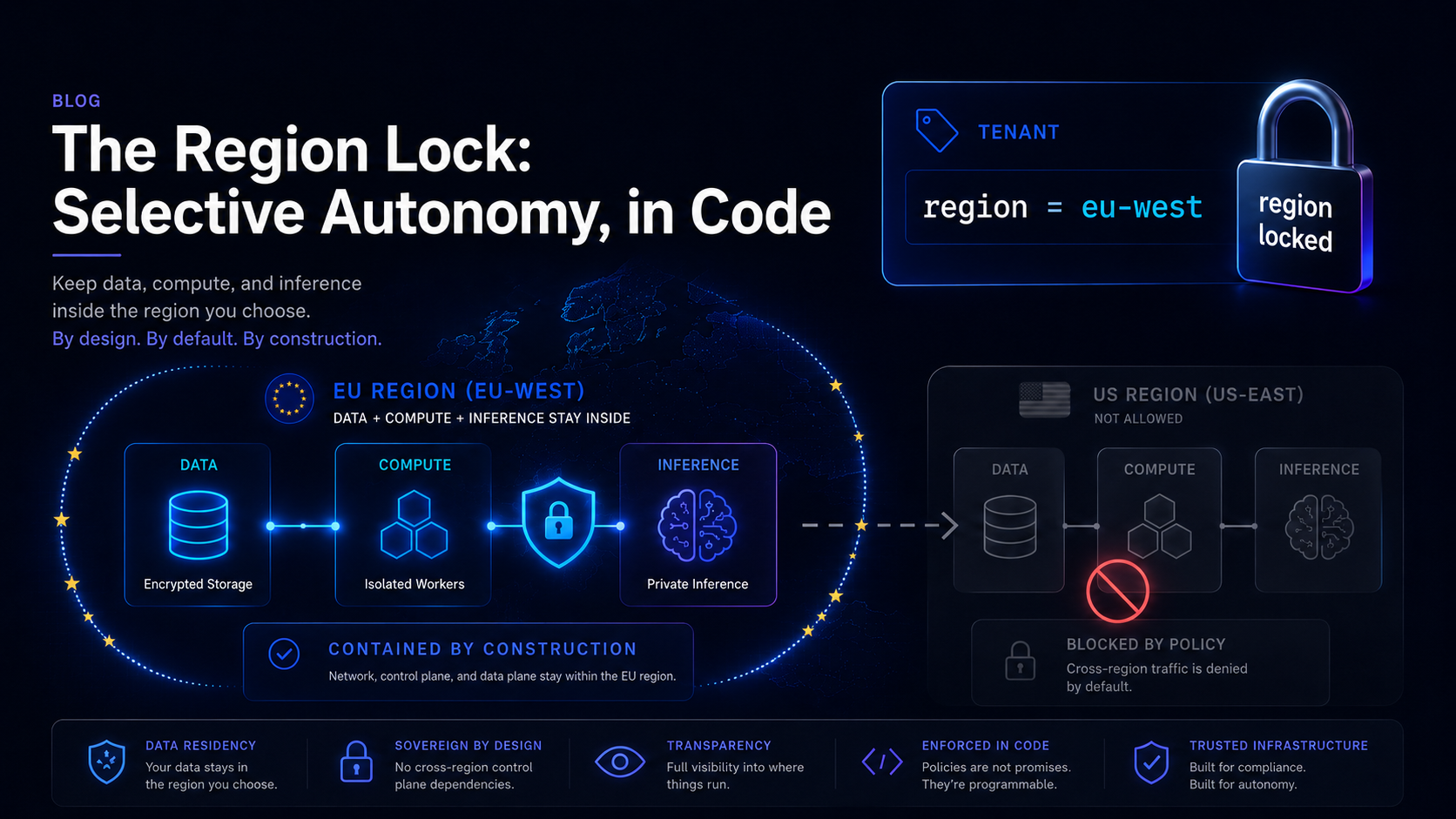
This post walks through how to make geography a first-class property of a platform: a single region choice that binds data, compute, and AI inference together; a lock that turns that choice into a commitment; enforcement at the points where bytes actually move; and a test that serves as the receipt.
Geography has to be a property, not a setting
The mistake most "regional" systems make is treating location as a deployment detail: something you configure per service and hope stays consistent. Sovereignty needs the opposite: one region label that every layer reads, so a tenant tagged for a given EU region writes to EU storage, runs on EU compute, and never even produces an internal request that a non-EU worker could pick up.
The goal is that a customer's data, and the compute that touches it, stay in a named region by construction, not by careful operations.
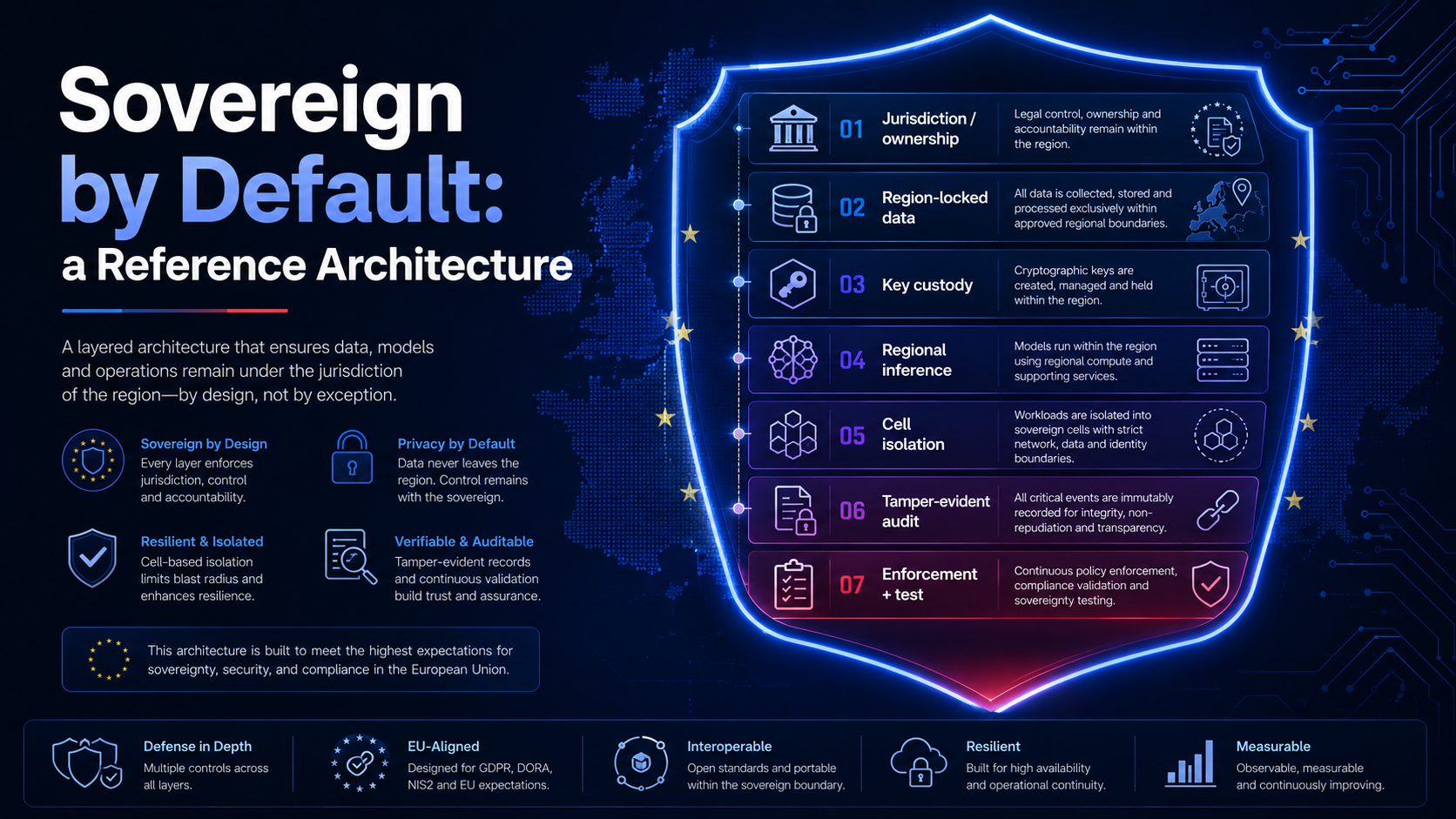
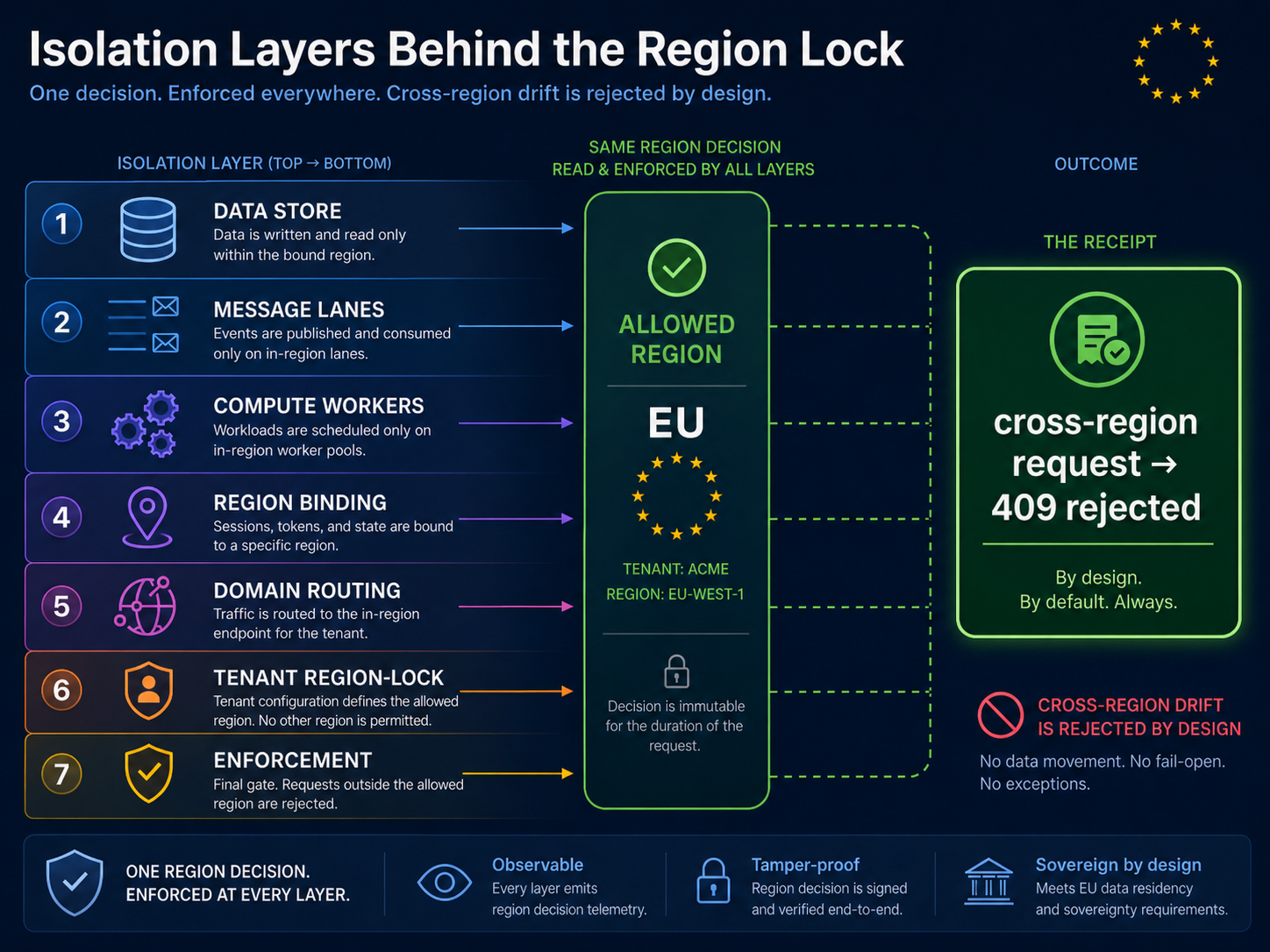
Seven layers, one region
Genuine regional isolation isn't a single feature; it's the same region decision enforced at every layer, so there is no seam where data can leak out.
| Layer | What it pins to a region |
|---|---|
| System of record | Per-region storage; replication policy can declare other regions strictly excluded |
| Message/coordination lanes | Per-region lanes; work for one region is never delivered to another |
| Compute workers | Each worker bound to one region and physically scheduled onto that region's hardware |
| Tenant registry | The tenant's region is recorded and read by everything above |
| Routing | Each region has its own entry point; cross-region routing is refused |
| Region lock (we call this "region lock"; it isn't a named industry primitive) | Once set, the region is a commitment, not a toggle |
| Enforcement | The data layer, the dispatch layer, and the audit layer each reject region drift |
The single most powerful primitive here is the explicit exclusion, and it is exactly what the Commission's own Cloud Sovereignty Framework implementation guidance requires at level SOV-3: "strict confinement of storage and processing to European jurisdictions, with no fallback to third countries." A replication policy that says, in effect, "replicate three copies inside this EU region, and zero copies anywhere else" means the data layer will not stream that tenant's data outside the region, not as a matter of policy, but because the system has no instruction that would let it. Sovereignty by absence of capability.
The region lock: a commitment device
Letting a tenant casually flip regions sounds like flexibility. It's actually a data-leak path: every easy migration is a moment when data crosses a boundary. So the region, once chosen, should lock.
A region lock is a commitment device: it makes the easy path the sovereign one, and forces the rare, legitimate case of moving a tenant to go through an explicit, consented, audited export rather than a quiet config change. Moving a tenant should cost the operator a deliberate act. That cost is the point.
Enforcement: sovereignty you can't accidentally undo
Layers and locks are only real if something refuses to break them. Three enforcement checkpoints close the loop, and they're deliberately redundant, defense in depth, so a mistake at one layer is caught at another:
- At the data layer. Before any read or write executes, the system asserts the tenant's region equals the local region. A mismatch is refused and recorded. This is the one checkpoint that actually touches bytes; if it's correct, the rest is reinforcement.
- At the dispatch layer. A request that arrives for a tenant belonging to another region is rejected outright (think: a clear "wrong region" refusal) rather than processed.
- At the audit layer. Every cross-region attempt is written to the tamper-evident log as a sovereignty event, so drift is visible and reviewable, not silent.
The receipt: a test that fails if sovereignty is broken
Here is the part that separates a sovereignty claim from a sovereignty guarantee, and it's the simplest idea in this whole post: write a test that tries to break the boundary, and assert that it fails.
Spin up a tenant in one EU region. From another region, attempt a read of that tenant's data. Assert that the attempt is refused. That single automated test is the receipt: proof that residency is wired through end to end, and a tripwire that catches the day a refactor quietly breaks the contract. Without it, every code change is a chance to silently lose sovereignty. The Commission's own framework relies "on self-assessment and self-declaration", a real gap, and one we propose closing with an automated cross-region test. If it isn't tested, it isn't sovereign, our proposal, not established practice.
And the inference, too: because the prompt is the data
One boundary is easy to forget: AI. An embedding or a prompt sent to a model in another region is a data transfer like any other. In fact, an embedding vector is a lossy fingerprint of the source text, so computing it elsewhere exfiltrates the source by reduction. Region-locking the data and then shipping the prompt to a central GPU farm abroad would defeat the entire design. So inference and embedding have to be per-region too, running on the same sovereign ground as the data. (We make this case in full in a later post, but it's a first-class constraint here, not an afterthought.)
How the Soveryne Cloud Foundation implements the dial
This is not a thought experiment for us; it's how the Soveryne Cloud Foundation is built. You choose the EU regions your data and compute live in, and that choice is bound across storage, processing, and routing: geographically controlled in transit and at rest, by design. Compute clusters are distributed across the EU and pinned to the regions you select. AI and LLM inference run on EU-sovereign infrastructure in-region, because the prompt is the data. And because the foundation is operated end to end by an EU entity, with no US-jurisdiction subprocessor in the data path, the region you choose is a commitment the architecture keeps, not a setting we promise to honor.
For organizations that need the strongest isolation, the Soveryne tier provides a dedicated environment with its own inference GPUs and on-premises options. The dial goes all the way to the top, and you can see exactly where it's set.
FAQ
What does "data residency by design" mean? That residency is enforced by the architecture at every layer (storage, compute, routing, and inference) rather than configured per service and trusted to stay consistent. The system cannot move the data out of region because it has no instruction that would let it.
How do you prove data never leaves a region? With enforcement at the data, dispatch, and audit layers, and an automated cross-region rejection test: attempt to access a region-locked tenant from another region and assert the attempt fails. That test is the proof.
What is a region lock? A commitment that, once a tenant's region is set, it can't be casually changed. Moving the tenant requires an explicit, consented, audited export and re-provision, so the easy path is always the sovereign one.
Why does AI inference need to be regional? Because a prompt or embedding sent to a model elsewhere is a data transfer: an embedding is a compressed fingerprint of the source. Region-locking data but not inference would leak the very data you protected.
A residency promise you can't test is just a promise. See the region-locked, EU-sovereign foundation that makes it provable: explore the Soveryne Cloud Foundation, or read the companion piece on why sovereignty is selective, not total.
Sources
- JRC, Open but Not Powerless: Towards a Common Understanding of EU Digital Sovereignty (2025): https://publications.jrc.ec.europa.eu/repository/handle/JRC144908
- European Commission, Cloud Sovereignty Framework explained (2026): https://commission.europa.eu/news-and-media/news/sovereign-cloud-framework-explained-2026-06-01_en
- French Senate hearing transcript (Microsoft France under oath, 10 June 2025): https://www.senat.fr/compte-rendu-commissions/20250609/ce_commande_publique.html

Prompt injection is the number-one security risk in AI applications, and here's the uncomfortable part: it probably can't be fully fixed. So the job isn't to "solve" it. It's to build so that when it happens, almost nothing bad can follow.
Read the next part
The sovereignty debate keeps offering a false choice: cut yourself off from the world's best technology, or accept permanent dependence. There is a third option, and it's the only realistic one.
Read the companion piece